One Person, Every Lead, Every Call
Lead Router does not treat leads as isolated records. It links them to a single person identity. Leads, calls, and engagements across every vertical are matched and deduplicated against that same person.
SHA-256
Exact match
Jaro-Winkler
Fuzzy match
Cross-partner
Dedup scope
Cross-vertical
Person view
The Basics
One person can be many records
A person identity that ties together every touch, instead of a pile of duplicate rows.
The same person fills out three forms, calls in twice, and gets nurtured over email. Without identity resolution that is six unrelated records. You cannot see that they are one person, you may sell the same lead twice, and you have no history to work from.
Lead Router resolves records to a single person identity. Leads across verticals, inbound calls, and engagements all link to the same person. Cross-partner deduplication uses that identity as its key, and both the admin People hub and the partner-portal People tab show the person with every record grouped under it.
How Identity Works
Resolution, linking, and dedup on one identity
Exact and fuzzy matching, household grouping, and merging. An admin can turn each option on or off.
Matching & linking
SHA-256 exact matching handles the clear cases. Optional fuzzy matching (Jaro-Winkler and soundex) catches typos and nicknames, and household matching groups by last name plus zip. An admin can turn each layer on or off.
Cross-vertical view
A cross-vertical accordion shows every lead, call, and engagement for a person in one place. Merge collapses duplicates that resolution missed, so the person record stays clean.
Identity-keyed dedup
Cross-partner deduplication uses the person identity as the key, so the same person is not resold into the same vertical inside the window even when the second lead comes in through a different partner or campaign. Buyer-level dedup uses the hashed email and phone stored for each buyer, so an individual buyer never buys the same contact twice.
Where You See It
One identity, two hubs, full history
Admins and partners both work from the resolved person, not from raw records.
Admin People hub
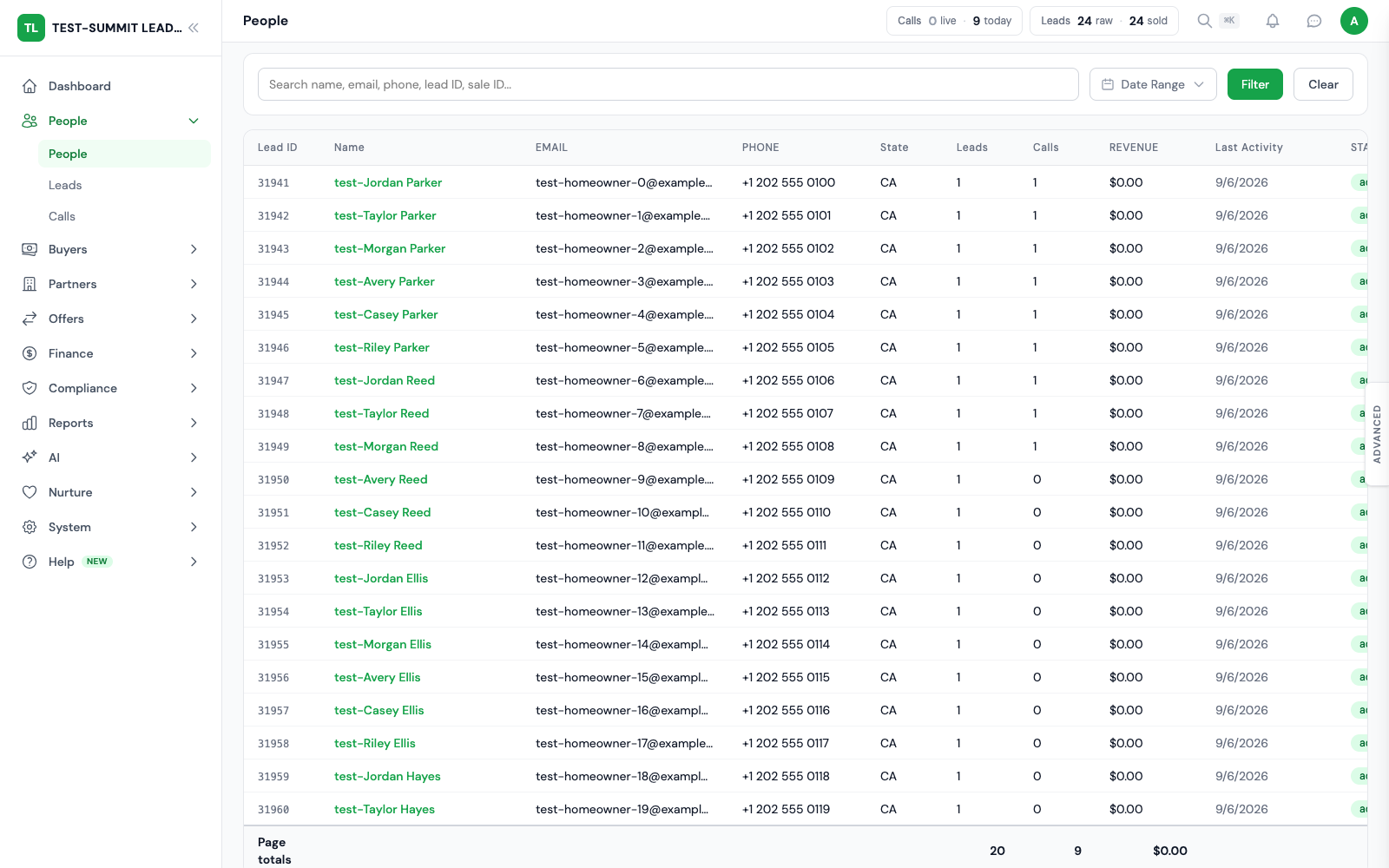
Search and browse resolved people across every vertical. Open a person to see their leads, calls, and engagements in one accordion, and merge any duplicates resolution did not catch.
Partner-portal People tab
Partners see their own people in the portal, keyed off the same identity resolution. The person view is consistent whether you are the platform admin or the partner who sent the lead.
Engagement history
Every touch (form submission, call, message) is kept against the person, so the history reads as one timeline instead of separate events you have to piece together by hand.
Admin-toggleable matching
Exact, fuzzy, and household matching are each switches you control. Turn fuzzy on when volume and typo rates call for it, and keep it off when you want only exact resolution. The choice is yours per deployment.
The Flow
From raw record to resolved person
Four steps that turn every inbound touch into part of one person identity.
A lead, call, or engagement arrives
Every inbound record (a form lead, an inbound call, an engagement) carries identifying fields. Instead of storing it as an isolated row, Lead Router asks whether it belongs to a person it already knows.
Identity resolution runs
A SHA-256 exact match on identifying fields resolves the obvious cases. Optional fuzzy matching (Jaro-Winkler and soundex) catches near-misses like typos and nicknames, and household matching groups by last name plus zip. An admin can turn each layer on or off, so you decide how aggressive resolution is.
Records link to one person
Matched records attach to a single person identity. Leads across different verticals, calls, and engagements all hang off the same person, viewable in a cross-vertical accordion that shows the full picture instead of scattered duplicates.
Dedup and dashboards key off identity
Cross-partner dedup uses the person record as the key. The same person cannot be sold into the same vertical twice during the dedup window, even through a different partner. Buyer-level dedup is separate. It uses the hashed email and phone stored for each buyer, so a buyer does not buy the same contact twice. The admin People hub and the partner-portal People tab both read the same matched person records, with full engagement history.
Separate cases without losing the original history
Case splitting lets an intake record become a separate case. Person identity is handled separately.

Create a child case
A configured qualifying disposition can automatically create a new lead and sale for an additional case. The child retains the reported external case ID and keeps a parent-child link for review.
Preserve the person relationship
Identity resolution can associate the child with the existing person when its matching data still identifies that person. Splitting a case does not promise a new person identity.
Keep the source traceable
Review parent and child records together to understand which case was separated and which recipient outcome belongs to each record. Original history remains available.
Respect eligible source records
Disposition-only records are not eligible sources for the split action. Confirm the case context before splitting; this workflow is different from merging duplicate people.
Frequently Asked
FAQ
What teams ask about person identity, matching, and deduplication.
What is a person identity?
A person identity is a single record that every lead, call, and engagement links to when it resolves to the same person. Instead of storing six unrelated rows for someone who filled out three forms and called twice, Lead Router ties them all to one person you can view and deduplicate against.
How does identity matching work?
A SHA-256 exact match on identifying fields resolves the clear cases. Optional fuzzy matching using Jaro-Winkler and soundex catches typos and nicknames, and household matching groups by last name plus zip. An admin can turn each layer on or off, so you decide how aggressive resolution is.
Does deduplication use the person identity?
Cross-partner dedup does. It uses the person record as the key. So the same person is not sold again into the same vertical during the dedup window, even if the second lead comes from a different partner or campaign. It matches people, not raw lead rows. Buyer-level dedup works another way. It uses the hashed email and phone stored for each buyer, so one buyer does not buy the same contact twice.
Can I control how aggressive matching is?
Yes. Exact, fuzzy, and household matching are each switches an admin can turn on or off. Turn fuzzy matching on when your volume and typo rates warrant catching near-misses, or keep it off when you want only exact resolution. The configuration is yours per deployment.
Where do I see a person?
In two places that read from the same resolved identities: the admin People hub, where you search and browse people across every vertical, and the partner-portal People tab, where partners see their own people. Both open into a cross-vertical accordion of leads, calls, and engagements.
What if resolution links two people who are not the same?
You control matching aggressiveness with the admin toggles, and the cross-vertical view lets you inspect what resolved together. Merge confirmed duplicate people when resolution misses a match. Inspect incorrect links separately; merging cannot undo an over-grouped identity.
See the Person
Stop treating one person as six records
Resolve leads, calls, and engagements to a single person identity. Cross-vertical view, identity-keyed cross-partner dedup, and a People hub for admins and partners alike.
Every module included at no extra license fee.