Call Tracking Software Built Into Your Lead Router
Track, route, record, and bill calls in the same platform that distributes your form leads and sends your email and SMS. One system, one report, one bill. If you run both phone traffic and web-form traffic, you can stop paying for two vendors.
Real-Time
Routing decisions
600+
API endpoints
AES-256
Encryption at rest
30+
AI tools built in
What It Does
What call tracking software actually does
Six core jobs, in plain English.
Dynamic Number Insertion
Every visitor on your landing page sees a different phone number. When they call, you know exactly which ad, keyword, or partner sent them.
Call Attribution
Ties each call back to source, campaign, partner, and session. Your reporting rolls up by any of those dimensions, same as form leads.
Call Recording
Store and review available recordings from call details. The effective recording policy and announcement decision are configured separately, with supported evidence and decision reasons retained.
IVR (Interactive Voice Response)
A single-digit menu that plays before the call connects to a buyer. The caller presses a key and that choice decides whether they reach a buyer, go somewhere else, or end the call.
Real-Time Routing to Buyers
The moment a call lands, the routing engine picks which buyer gets it based on filters, caps, price, and priority. The decision happens before the caller hears a ring.
Pay-Per-Call Billing
Charge buyers per call or per minute. Pay partners per call or per qualified call. Stripe-backed invoicing on the same schedule as your form-lead billing.
Features
Every call-tracking primitive you expect
Call-only operators compare this list to what Ringba or CallRail ship. It matches, then adds form-lead distribution and messaging.
Dynamic Number Insertion (DNI)
Swap the tracking number on your landing page based on source, campaign, keyword, or session. Each visitor sees a unique number so every call attributes back to the right traffic source.
Real-Time Bidding (RTB), in controlled rollout
Buyers bid on inbound calls in real time. The highest qualified bid wins, the call routes to that buyer, and the bid sets the buyer price. Partner payouts follow their own terms. It uses the same ping-post logic as form leads, applied to phone traffic. Call RTB is in controlled rollout and enabled for select tenants. Contact us to be included.
Ping Tree Call Routing
Ordered waterfall across contracts by priority, weight, or price. If the top buyer is capped or filtered out, the call falls through to the next qualified buyer with no silence on the line.
IVR Menu Before the Transfer
A single-digit menu decides what happens next: connect the caller to a buyer, send them to another destination, or end the call. Caller details like zip and state do not need a prompt. They attach automatically from the tracking number's DNI tags and the caller ID.
Call Recording with Consent Timestamp
Recording follows the settings on the number, offer, and contract that apply to the call. Recording announcements follow a separate policy: supported upstream attestations and operator overrides can change whether one plays, and the reason for the decision is kept. Authorized users can review and download available recordings from call details.
Call Routing by Geo, Priority, Weight
State, area code, and zip targeting per contract. Weighted round-robin for splitting volume. Priority ordering for waterfall. Same filter engine that powers form-lead contracts.
Cap Management (Daily, Weekly, Monthly)
Per-contract caps on call count and on spend, plus a ceiling on concurrent calls. Counters update one at a time, so calls that land together cannot push a contract past its cap. Caps reset in the tenant timezone, not UTC.
Call Attribution and Source Tracking
Every call tied to partner, campaign, source, keyword, session. Reporting rolls up by any of those dimensions. The same attribution model used for form leads, so multi-channel reports line up.
Full Call Lifecycle Tracking
Every call is tracked from start to finish, including calls that never connect. A routing trace records each contract the engine checked and why it was filtered out, capped, or won. Waterfall failover tries the next qualified buyer before the call is dropped. IVR and whisper prompts can be set up. If no buyer qualifies, the caller hears a message and the call ends, and the trace tells you exactly why.
Missed-Call Visibility
Every unanswered call is logged with the full attempt trail: which buyers were tried, how long each rang, and why each leg ended. Those attempts surface as call events in reporting, so a call nobody picked up is a number you can act on instead of a gap in the log.
Pay-Per-Call Billing Integration
Per-call and per-minute billing on the buyer side. Per-call payouts on the partner side. Stripe-backed invoicing, one bill that covers calls plus form leads plus messaging.
What Is Different
Why operators consolidate onto Lead Router
Four concrete reasons.
Native platform, not three subscriptions
Call tracking, form-lead distribution, and email/SMS messaging on one login, one database, one bill. Operators running Ringba plus a lead router plus a messaging vendor typically cut two line items.
Atomic cap enforcement across periods
Daily, weekly, and monthly caps on call count and on spend, plus a concurrency ceiling. Counter updates are race-condition-safe so parallel calls can not double-count. Caps reset in the tenant timezone, not UTC.
Shared infrastructure with form leads
Call routing and call attribution share the same filter engine, contract model, and reporting views as form leads. One audit trail covers calls and forms. One pivot table breaks down revenue by source across both.
Security built in across every channel
AES-256-GCM encryption at rest, TCPA-aware intake, consent tracking, GDPR and CCPA data-request handling, row-level tenant isolation, and a full audit log. One set of compliance records covers calls, forms, and messages.
Who Uses It
Use cases
Three operator profiles where call tracking pays off inside the broader platform.
Pay-per-call affiliates
Run calls from affiliate networks, monetize via fixed-price contracts with buyers (or RTB, in controlled rollout). Ping tree waterfall, per-minute billing, consent-tracked recordings. If the affiliate also sells form leads, one account covers both.
Performance marketing agencies
Agencies with clients in insurance, mortgage, solar, legal, home services. Track calls and form leads side by side per client. White-label reporting. Per-tenant isolation so client A never sees client B.
Direct advertisers
Advertisers in insurance, mortgage, solar, legal, home services who buy their own calls and form leads. Unified intake, deduplication across channels, one compliance posture across phone and web.
Compared To
Compared to standalone call tracking
Most call-tracking products are standalone. Here is the tradeoff.
Standalone call-tracking products (the pay-per-call platforms in the affiliate vertical, and the marketing attribution products used by SMBs) are mature and good at what they do. If phone calls are 100% of your traffic and you have no plan to add form leads, email, or SMS, they are a reasonable choice.
The tradeoff is scope. A standalone call tracker does not route a web form, does not send an SMS follow-up, and does not share a compliance audit trail with your other channels. The moment your operation adds a second channel, you add a second vendor, a second bill, and a second set of compliance rules to manage.
Lead Router covers the same call-tracking features (DNI, ping tree, IVR, recording, caps, attribution, and RTB in controlled rollout) and also handles form leads and messaging on the same platform. For a side-by-side comparison, see Lead Router vs Ringba.
Pricing
One usage-based bill
No per-channel subscriptions. Published usage rates and applicable carrier fees.
One monthly plan includes usage credits for calls, form leads, and messages. Extra use draws from your credit balance at the published rates. Call minutes and any carrier charges still apply. Check the required settings and test delivery before sending live traffic.
See PricingConnect attribution to the actual call outcome
Call attribution, delivery, and recording each have their own setup requirements.

DNI pools and session attribution
Dynamic number insertion assigns tracking numbers from pools you set up and links each call to its session and source data. Size pools for your traffic, and check the number-to-session link when attribution is incomplete.
Call RTB and SIP
Accounts with the feature enabled can use call real-time bidding and SIP integrations. Ping validity, expiry, available capacity, and buyer readiness all matter before a winning route can take the call. Call RTB is still in controlled rollout, so request enablement for your account before planning production traffic.
Sandbox and readiness
Use the supported call integration sandbox and readiness tools to verify configuration. A successful bid is not proof that a destination will answer or that a later call qualifies for billing.
Recordings and downloads
Authorized users can review and download available recordings. Recording availability depends on the call configuration and provider result; recording policy is separate from whether a disclosure announcement plays.
Upstream announcement evidence
A partner that already played a recording announcement can pass that proof along with the call. Operator overrides and the saved reason explain why an announcement played or was skipped. That proof on its own does not switch recording on or off.
Dial timeline
Review attempted destinations, expected ring time, and actual dial events. The timeline separates a caller who hung up during an attempt from a buyer destination that failed, which makes short or failed calls easier to diagnose.
A closer look
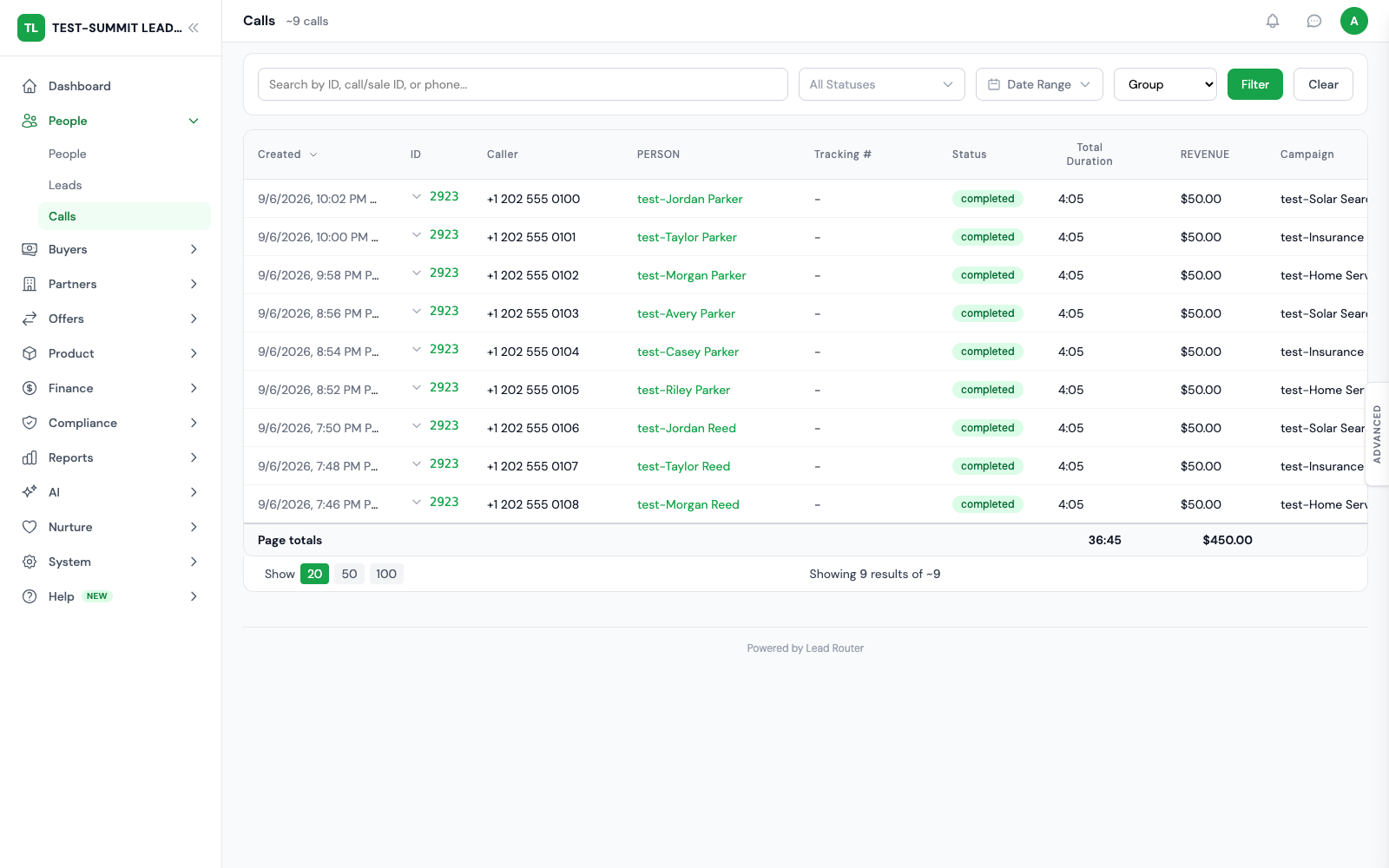
Inspect a call in the actual workspace
Follow a prepared call record into its details and linked activity. This tour uses fictional records. No real phone call is placed.

Read the video transcript
- 0–12 seconds: The calls workspace lists prepared sample calls with their status and context.
- 12–26 seconds: Opening a sample call shows its detail view, including the recorded duration and related records.
- 26–40 seconds: Look through the record sections and linked activity. These records show the interface only. No live phone call was made.
Frequently Asked
FAQ
Answers operators ask before swapping call-tracking vendors.
What is call tracking software?
Call tracking software gives each marketing source (ads, landing pages, campaigns, partners) its own phone number. That way every inbound call can be traced back to the traffic that produced it. Most tools also add call recording, IVR (phone menus), routing rules, caps, and reports. Operators use it to prove which ads produce calls, send calls to the right buyer or agent, and bill partners or buyers per call.
How is Lead Router's call tracking different from Ringba?
Lead Router covers the same call-tracking features as Ringba: dynamic number insertion, ping tree routing, IVR, call recording, caps, geographic routing, and real-time bidding. (Call RTB is in controlled rollout and enabled per tenant.) The difference is scope. Ringba focuses on pay-per-call. Lead Router handles calls, form-lead distribution, and email/SMS messaging on one platform. Operators with traffic on more than one channel move to Lead Router to cut vendors and keep reporting in one place.
Does Lead Router support pay-per-call?
Yes. Per-call and per-minute billing are both supported on the buyer side, and per-call or per-qualified-call payouts are supported on the partner side. Billing is Stripe-backed and runs on the same invoice as form-lead and messaging usage.
Can I record calls?
Recording follows the settings on the number, offer, and contract that apply to the call. Recording announcements follow a separate policy: supported upstream attestations and operator overrides can change whether one plays, and the reason for the decision is kept. Authorized users can review and download available recordings from call details.
Do I need my own telephony account?
No. Calls run on the platform's managed telephony. Numbers, recordings, and call events are all handled for you. There is no separate carrier account to set up or maintain, and provisioning a tracking number takes a click.
How accurate is call attribution?
Attribution is DNI-based and per-session. Each visitor sees a unique tracking number tied to their source, campaign, keyword, and session. When they call, that attribution is attached to the call record. Reporting rolls up calls and form leads by the same dimensions so multi-channel numbers line up.
Ready to Consolidate?
Route calls, form leads, and messages from one platform
Stop stacking a call tracker, a lead router, and a messaging tool. Run the whole stack on Lead Router with usage-based pricing and unified reporting.
Every module included at no extra license fee.