Mortgage Lead Routing and Distribution
Purchase, refi, cash-out, HELOC, VA, FHA, reverse. Route mortgage leads to the right lender by credit bucket, LTV, loan type, and state license. Consent evidence on every lead, per-contract calling windows, caps per lender, attribution from click to lender delivery.
Real-Time
Routing decision
On every lead
Consent evidence
9+
Loan products
Per buyer
State license filter
The Basics
Mortgage is a hard vertical to route
Heavy regulation sits on top of a high-cost, high-value lead. One compliance slip can lead to a costly TCPA class action.
Mortgage intake combines consent review, lender licensing, and buyer eligibility. On January 24, 2025, the Eleventh Circuit vacated the one-to-one and logically-and-topically-associated consent restrictions in Part III.D of FCC 23-107. Those vacated restrictions are not a current federal one-to-one requirement. Existing TCPA obligations still apply to the relevant calls and texts. Keep the actual disclosure and the evidence supplied with it, and set state targeting for each buyer’s licensed service area.
On top of compliance, mortgage leads need heavy filtering. A borrower with a 580 FICO score has no value to a prime lender but real value to a government-loan lender. A cash-out refi at 85 percent LTV fits one contract and fails another. Purchase leads route differently than refi leads because the lender teams, pricing, and time to close are different. Time of day matters because TCPA calling windows follow the consumer, not the lender.
Lead Router gives mortgage operators a contract-based routing engine that handles all of it: consent evidence on every lead, number filters on credit and LTV, state-license targeting, separate offers for each loan product, daily and weekly caps per lender, and calling windows per contract. The same platform handles web form leads and live-transfer calls, so one set of rules covers both.

What Breaks Without The Right Platform
Mortgage-specific routing challenges
Six things mortgage operators deal with that general-purpose lead distribution tools do not solve cleanly.
TCPA consent and 47 U.S.C. section 227
Statutory damages of $500 to $1,500 per violating call or text. Without consent evidence tied to each lead, every party that handled the lead may face a demand letter.
Consent evidence and outreach authorization
Keep the exact consent wording and any seller names the consumer saw. Review whether that consent covers your planned calls or texts. A stored certificate alone does not establish permission.
RESPA restrictions on fee splits
RESPA Section 8 bars kickbacks for settlement-service referrals and unearned fee splits on federally related mortgage loans. Keep clear records of the service, price, and buyer.
NMLS state licensure matrix
Lenders are licensed per state, not federally. A mis-routed lead to an unlicensed state is both a wasted lead and a regulatory problem.
Credit-bucket and LTV scoring
Prime, near-prime, and non-prime lenders all want different slices. Contracts need numeric range filters on credit, LTV, loan amount, and DTI, not just zip and state.
High-LTV vs low-LTV pricing
The same consumer at 70 percent LTV and 95 percent LTV is two different products. Contracts need to carry different filters and different prices per LTV bucket.
How Lead Router Solves It
Six capabilities built for mortgage
Contract-based routing that respects the compliance stack and the underwriting reality of mortgage lending.
Consent evidence on every lead
Lead Router stores the TCPA consent language shown at submission, the timestamp, the IP, and the user agent, plus TrustedForm and Jornaya certificate references when your intake captures them. That data rides on the lead record and on every posting log entry. If a TCPA demand letter arrives, the evidence trail is already there. Set up evidence collection and outreach controls for your program’s requirements.
Loan-type, LTV, and credit-bucket filtering
Contracts accept numeric range filters on credit score, LTV, loan amount, DTI, and property value, plus set-match filters on loan purpose (purchase, rate and term refi, cash-out refi, HELOC, reverse) and occupancy (primary, second home, investment). One contract can be set for 680+ FICO cash-out refis under 80 LTV in 22 states, and the engine only matches leads that fit.
State licensure matrix
Every lender maintains its own NMLS licensure footprint. Lead Router stores the licensed-states list per buyer and blocks any lead from a non-licensed state at the contract filter layer. A lender not licensed in California never sees a California lead. The rejection is logged with a reason code so broker ops can audit the routing decision.
Multi-lender distribution for purchase and refi
Offers with a multisell distribution rule fan a single lead out to multiple winning lenders (for example, top three by bid). Exclusive offers send to one. Hybrid sends to up to the buyer limit you set. Purchase leads and refi leads run on separate offers and separate contracts, so pricing, caps, and filters stay clean per product.
Caps per lender per day, week, month
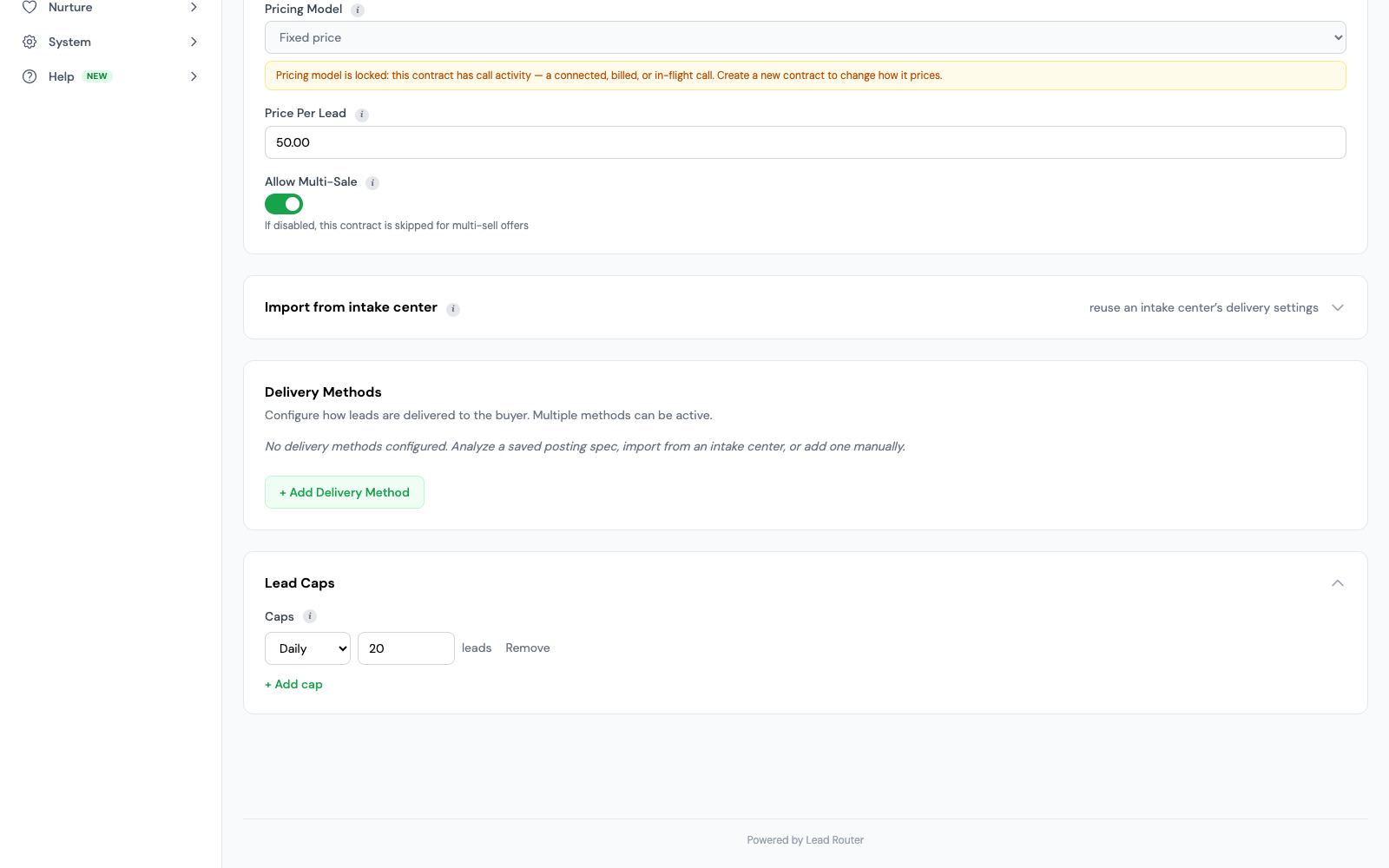
Every contract has daily, weekly, and monthly volume caps that the platform tracks as leads are sold. Once a lender hits its cap for the period, the contract stops matching until the period rolls over. Caps prevent one lender from draining inventory at the start of the day and also prevent over-delivery when a buyer runs out of capacity mid-week.
Calling windows enforced per contract
TCPA limits outbound calling to between 8am and 9pm in the consumer's local time. Every Lead Router contract has its own schedule (a time zone plus day-of-week and hour windows). The routing engine skips any contract whose window is closed. Set each call-center lender's schedule to the calling hours your TCPA policy allows. Split contracts by state where the rules differ. Web-delivery-only contracts can keep receiving around the clock.
Inside Lead Router
Let buyers set their daily lead limit
- Define the capacity
- Collect the volume limit agreed with the lender.
- Finish the connection
- Your team sets up delivery and checks the contract before traffic starts.

Loan Products
One platform, every mortgage product
Each product runs on its own offer and its own contracts. Filters, caps, and pricing stay separate by design.
- Purchase. First-time homebuyers and repeat buyers. Filter by FICO, property value, down payment percentage, and state.
- Rate and term refinance. Borrowers lowering rate or shortening term. Filter by current rate, loan balance, and property value.
- Cash-out refinance. Tap equity for debt consolidation or home improvement. Filter by LTV ceiling, target cash-out amount, and credit.
- HELOC and home equity loan. Second-lien products. Filter by combined LTV, first-lien balance, and available equity.
- VA loans. Eligible veterans and active duty. Filter by service flag and target entitlement.
- FHA loans. Government-backed purchase and refi. Filter by FICO floor, loan limit by county, and DTI.
- Reverse mortgage. HECM for borrowers 62 and up. Filter by age floor, property value, and primary-residence flag.
- Jumbo. Loan amounts above conforming limits. Filter by loan amount floor, reserves, and property type.
- Non-QM. Bank statement, DSCR, and alt-doc products. Filter by self-employment flag, rental income, and reserves.
Delivery
Plugs into the lender stack
Standard mortgage JSON format, webhook or REST delivery, TrustedForm and Jornaya certificate support.
Lead Router delivers over webhook or REST to any lender LOS, CRM, or custom endpoint that accepts a lead post. Teams often route leads into systems like Encompass, LendingPad, or Velocify using their standard lead-intake endpoints. Zoho is a native CRM connector. Salesforce and HubSpot connectors are in development. Delivery is set per contract, so each buyer gets the payload shape and auth method they expect. Failed deliveries retry automatically with growing delays and log the full request and response for audit.
Certificate URLs from TrustedForm and Jornaya travel with the lead and are stored on the lead record. Buyers can check consent on their end before accepting. The standard mortgage JSON carries loan officer fields, borrower and co-borrower blocks, a property block (address, value, use), loan purpose and amount, credit indicators, and the full set of consent metadata.
For call campaigns, Lead Router bridges the consumer to the lender call center via a live transfer with full attribution (campaign, partner, source, offer, contract, buyer rep) on the call record. No separate call-tracking vendor required. See Live Lead Transfer for the call-bridge detail.
Frequently Asked
FAQ
Questions mortgage operators ask before switching lead distribution platforms.
Does Lead Router handle RESPA requirements?
Lead Router captures attribution, consent metadata, and per-buyer pricing on every lead. This is the evidence lenders need to document RESPA Section 8 compliance. RESPA is a disclosure and anti-kickback framework, not a certification. The platform gives lenders the records to support their own compliance position. Pricing per buyer is explicit and auditable, which matters for federally related mortgage loans.
Can it filter by credit score or LTV?
Yes. Contracts accept numeric range filters on credit score, LTV, CLTV, loan amount, DTI, property value, and any custom numeric field on the lead. Set a contract for 680 to 740 FICO cash-out refis under 80 LTV and the engine only matches leads that fit every range. Ranges are inclusive on both ends and can be open-ended (for example, 740 and up).
How does it deliver into an LOS like Encompass or LendingPad?
Lead Router delivers over webhook or REST to any lender LOS, CRM, or endpoint that accepts a lead post. Teams often route leads into systems like Encompass, LendingPad, or Velocify using their standard lead-intake endpoints. Each contract has its own delivery settings (URL, auth method, payload shape, retry policy). Failed deliveries retry automatically and log the full request and response for audit. Custom payload mapping is supported per buyer.
Can I run purchase and refi leads through the same platform?
Yes. Purchase and refi run on separate offers, each with its own set of contracts. Pricing, filters, and caps stay separate for each product. You can also split by loan type (conventional, FHA, VA, jumbo, non-QM, reverse) and by LTV band. The same campaign can feed multiple offers if the intake form captures enough data to classify the lead.
How is mortgage consent evidence retained?
When the consumer submits the form, Lead Router captures the consent text shown at submission, the timestamp, the IP, and the user agent. These are stored with the lead record, along with TrustedForm or Jornaya certificate references when the intake supplies them. If the consent language names specific lenders, that naming is kept word for word. Naming the lenders on the intake page itself is still up to the operator. The consent record is available on the lead API and posting log for audit.
Built For Mortgage
Route mortgage leads with compliance tools built in
Consent evidence on every lead. Credit and LTV filters. State-license targeting. Per-contract calling windows. Caps per lender. One platform from form submit to lender delivery.
No feature tiers. Usage is metered and billed as you go.