The mortgage lead market in 2026
US mortgage originations are running at roughly $1.8 trillion a year in 2026. The pay-per-lead market is worth between $400 million and $600 million per year, depending on how you count live transfers, call leads, and aged data. The mix of products inside that spend has shifted a lot over the past three years. Refinance leads dominated during the low-rate window of 2020 through 2022. In 2026, rates are still high compared with that cycle. Purchase leads now cost less per lead than refi did at the peak, but they take longer to convert and come in lower volume. Refi spend has narrowed to three areas: rate-and-term refis for adjustable-rate resets, cash-out refis tied to home equity, and HELOC.
There are more product types than most new buyers expect. Purchase, rate-and-term refi, cash-out refi, HELOC, home equity loan, reverse mortgage, VA, FHA, USDA, jumbo, and non-QM each trade in their own sub-market, with their own suppliers and their own pricing. A lender buying leads for three or four of those products will see very different cost per acquisition and very different close rates on each. Treating them as one bucket is the fastest way to lose money.
Mortgage lead sources include publisher networks, comparison sites, call centers, and resellers. Check how each supplier collected the records and whether it is currently allowed to sell them. On January 24, 2025, the Eleventh Circuit vacated the one-to-one and logically-and-topically-associated consent restrictions in Part III.D of FCC 23-107. Those vacated restrictions are not a current federal one-to-one requirement. Existing TCPA obligations still apply to the relevant calls and texts. Read the court opinion.

Lead types and pricing
Mortgage lead pricing in 2026 is heavily segmented by product, exclusivity, and freshness. The ranges below reflect typical retail pricing for a mid-sized lender buying at steady volume. Volume discounts, seasonal pricing, and supplier-specific negotiation all move these numbers.
- Trigger leads (hard inquiry). $15 to $40 retail. These come straight from credit bureau hard inquiry data, meaning the consumer just had their credit pulled for a mortgage application. They have the highest raw intent and the shortest window to convert (24 to 72 hours before the consumer commits elsewhere). They also carry the heaviest compliance burden under FCRA Section 1681b pre-screen rules. Not every operation should buy these.
- Trigger leads (soft inquiry). $5 to $15. Built from soft inquiries (credit monitoring signals, rate-shopping traffic without a full mortgage pull). Lower raw intent but lighter regulatory footprint since the FCRA pre-screen framework is less constraining on soft-inquiry data.
- Refi leads (real-time). $10 to $30 exclusive, $4 to $12 shared. The consumer just filled out a refinance quote form. Exclusive versions sell to one lender. Shared versions sell to three to five lenders on the same offer (multisell). Intent is higher than with aged data but varies a lot by source. A LendingTree refi lead is priced differently from a refi lead off an affiliate landing page.
- Purchase leads. $20 to $60 exclusive, $8 to $20 shared. These cost more than refi leads for three reasons. The buyer takes weeks or months to convert instead of days. Volume is lower across the market. Close rates vary more. Purchase leads often come with extra routing details (target price range, timeline, pre-approval status) that split pricing further.
- HELOC leads. $12 to $30 exclusive. Positioned between refi and cash-out. Filterable by combined LTV, first-lien balance, and available equity.
- Reverse mortgage leads. $30 to $100. Smaller consumer pool (age 62 plus for HECM), higher lifetime value per funded loan, more expensive generation per lead. A niche but profitable segment for lenders with a reverse product line.
- VA and FHA leads. $15 to $40. Filter by military service flag (VA) or FICO floor and DTI ceilings (FHA). Government-loan shops pay more for properly qualified leads because the origination spread is better on those products.
- Aged leads (60 plus days old). $0.50 to $3. Consumer submitted a form two to twelve months ago. Low raw intent but cheap enough to work for email nurture, long-cycle conversion, and re-qualification campaigns. Good for filling gaps, bad as a primary source.
- Live-transfer leads. $75 to $250 per transfer. Consumer is already on the phone, pre-qualified by a call center, and warm-transferred to your loan officer. Highest conversion rate of any lead type, shortest cycle, highest unit cost. Common in purchase and refi, harder to source cleanly in HELOC and reverse.
Where to source mortgage leads
Choose suppliers based on lead quality, cost, volume, and how they collect consent. Test each source and compare results before you increase your spend.
Direct publishers. LendingTree, Bankrate, NerdWallet, Zillow Mortgage Marketplace, Realtor.com. These are the consumer sites where borrowers actively shop for rates. Quality is generally the best in the market. Volume is large and steady. Pricing is at the top of the range. These platforms document consent capture well, which matters for TCPA defense. The downside: every competitor is on these marketplaces too, so response speed, quote quality, and call cadence matter even more.
Lead aggregators. Companies that buy leads from several upstream sources (publishers, call centers, affiliates, their own traffic) and resell them as one bundled product. They cost less than direct publishers, but quality varies widely. Vet the aggregator carefully. Ask for a sample of their consent capture, TrustedForm coverage, source mix, and return policy before you commit real spend.
Credit bureau trigger programs. Equifax, Experian, TransUnion, and Innovis sell hard-inquiry and soft-inquiry trigger data directly to approved lenders. This is a regulated program under FCRA Section 1681b with firm requirements on pre-approved offer of credit and opt-out list suppression. See the companion post on mortgage trigger leads for the compliance mechanics and operational details.
Affiliate networks. Affiliate networks bring together publishers and resell their traffic as leads. Quality and consent records vary by source. Review each offer and publisher before buying, then track results by source.
In-house traffic. Your own landing pages with paid ads (Google Search, Facebook, YouTube, TikTok for younger refi prospects). You get the most quality control because you own the consent language, the form, the TrustedForm capture, and the traffic source. You also take on the most work. Most lenders who run in-house traffic also buy from publishers and aggregators. They treat in-house traffic as a margin product rather than their main source of volume.
What to vet before buying
A standard vetting checklist before sending money to a new supplier. Skipping any of these items has burned operators in the past, so build the list into your procurement process and require satisfactory answers before the first test batch.
- TCPA consent documentation. Ask the supplier for the consent record, including the wording shown, timestamp, IP address, and any certificate link. A certificate can help document what happened. It does not, by itself, prove you have permission to call or meet every TCPA rule.
- Review consent evidence. The FCC one-to-one restrictions were vacated in January 2025. Ask the supplier for the actual disclosure and session evidence, and verify authorization for your planned outreach.
- Return policy. Standard windows are 7 to 15 days. Disputed leads (bad phone, already closed with another lender, not-interested on first contact with documentation, fake data) should be refundable. Get the policy in writing with clear dispute reason codes. A supplier that will not refund anything is a supplier you do not want.
- Exclusivity level. Is this lead sold to one buyer (exclusive) or several buyers (shared, also called multisell)? If shared, how many buyers maximum? The answer should be in the contract, not verbal. Pricing and close-rate math only work when you know the denominator.
- Lead freshness. Real-time (ping-post or direct post inside 60 seconds of form submit) is priced and converts very differently from 24-hour-old or 7-day-old data. Aged data is its own category. Require the supplier to document the age.
- Source attribution. Which publisher ran this traffic? Which campaign? What did the landing page and consent language look like? Suppliers who refuse to disclose upstream sources tend to be hiding quality problems. You do not need publisher names every time, but you should be able to audit a sample.
- Credit bureau opt-out compliance. For trigger leads, the supplier must be suppressing against the bureau opt-out list (the 1-888-5-OPTOUT registry) and any internal opt-out lists. FCRA non-compliance here is a six-figure problem if it goes wrong.
- State-level restrictions. Several states impose additional restrictions on trigger lead outreach, on prerecorded calls, or on text messaging. Florida and Oklahoma notably have stricter state mini-TCPA regimes. Confirm the supplier suppresses against state registries where applicable.
How to structure a lead-buying program
Treat every new supplier as an experiment, not a commitment. The steps below apply whether you are buying $10,000 a month or $10 million a month; the dollar figures scale but the structure does not.
Start with a limited test budget, usually $2,500 to $10,000 per new source. The test should produce enough leads to give you a reliable read on contact rate, intent rate, and close rate. It does not need to turn a profit on the first batch. Tests that are too small lead to decisions based on noise. Tests that are too large waste money on suppliers you would have dropped after 500 leads anyway.
Track three rates for each source, product, and state. Contact rate shows how many leads you reach. Intent rate shows how many people you reach qualify and want to move ahead. Close rate shows how many qualified leads fund a loan. Multiply those three rates by the average revenue from a funded loan to estimate revenue per lead. Compare that result with your cost per lead.
Watch quote-to-close ratios by source. A source with a high contact rate but a low close rate usually points to bad data or consumers who were not qualified. A source with a low contact rate but a high close rate usually points to a timing or call cadence problem you can fix on your side. Track the reason codes for each outcome (bad number, already closed, not interested, callback scheduled, duplicate) and chart how they spread across each source. Patterns show up fast once you have a month of data.
Negotiate return windows that fit your workflow. The standard is 7 to 15 days from purchase. Push for longer windows on purchase leads, where the sales cycle takes longer. Accept shorter windows on real-time refi leads. A 24-hour window for leads who answer and say they are no longer interested is reasonable there. Set up automatic return submissions in your CRM so outcome codes flow back to the supplier without manual work.
Build a portfolio with several sources. No single supplier should make up more than 40 percent of your volume. Depending on one supplier is a serious risk. That supplier can raise prices, get acquired, get caught in a TCPA class action, or simply have a bad month. Then use a routing platform to send leads to loan officers based on state license, product (purchase, refi, HELOC, or reverse), credit bucket, and availability. Lead Router does this natively. Contracts carry state license lists, numeric range filters on FICO and LTV, loan-purpose filters, and per-loan-officer caps that hold even when leads arrive at the same time.
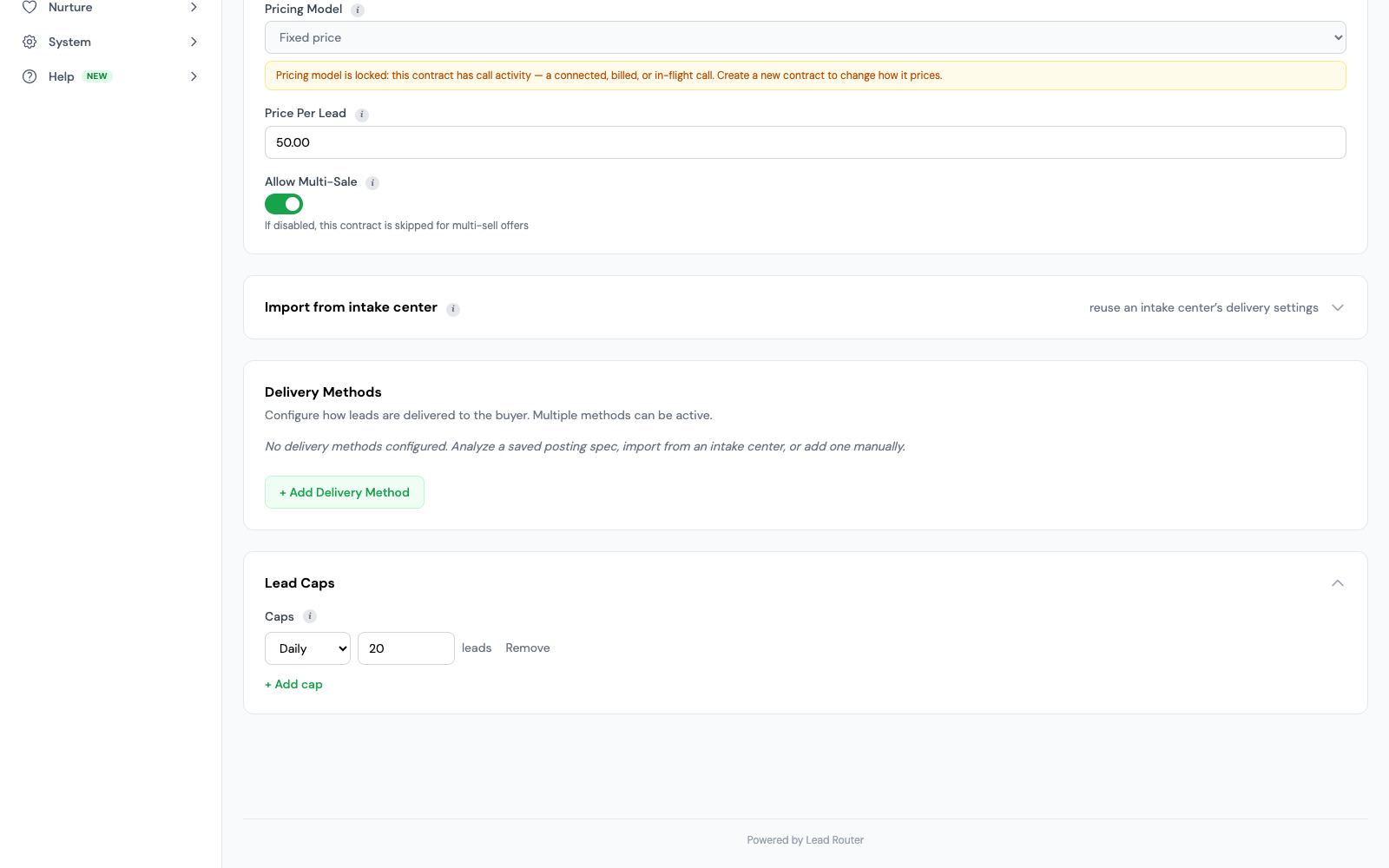
Turn a buying plan into a routing setup
This example shows the setup work after your team reviews the lead source and buying terms.
- 01
Define the buyer
Target states
Loan types
Write down what the buyer can handle.
- 02
Set the controls
Filters
Schedule and caps
Put the agreed limits on the buyer’s contract.
- 03
Check delivery
Destination
Recorded response
Test the connection and inspect the delivery result.
Common buyer mistakes
Scaling a new source before vetting it. This is the most expensive mistake. A buyer signs up, runs a 200-lead test, sees a decent contact rate, and right away signs a $25,000 monthly commitment. Two months in, the close rate is half of what they projected. The supplier mix turns out to be 70 percent aged data sold as real-time. And there is no way out of the contract. Test batches exist for a reason. Do not skip them.
Ignoring consent records until a TCPA complaint arrives. TrustedForm certificates cost nothing to archive. Store them with each lead from day one. When the first TCPA demand letter shows up (and if you buy enough leads, one will), you will need the certificate URL, the consent language, the timestamp, and the IP address to build a defense. You cannot build that archive after the fact, because the certificates expire.
Buying exclusive leads without putting exclusivity in the contract. Exclusive is only worth the extra cost if it is actually exclusive. Some suppliers sell the same lead to two buyers at the same time and call both of them exclusive. They count on neither buyer checking. Run your own dedup across suppliers (the same email or phone within 48 hours from two different suppliers is a red flag). Put exclusivity in writing with a penalty clause.
Not running dedup across sources. The same consumer fills out three comparison forms in an hour, and three aggregators all sell their version of the lead to your company. Without cross-source dedup you pay three times for one consumer. A routing platform with a 24 to 72 hour dedup window on email plus phone catches this cleanly.
Routing all leads to one loan officer instead of matching to state licensure. An LO licensed in California cannot legally originate a loan in Texas, but mis-routing still happens when routing rules are spreadsheet-driven. State license matrices in the routing platform prevent it structurally.
Regulatory landscape in 2026
TCPA (47 U.S.C. § 227) class action activity remains high. Statutory damages of $500 to $1,500 per call or text sent without consent add up fast across large call files. Plaintiff firms target mortgage operators in particular because call volumes are high. Documented prior express written consent is the main defense. It has to be named, timestamped, and stored.
On January 24, 2025, the Eleventh Circuit vacated the one-to-one and logically-and-topically-associated consent restrictions in Part III.D of FCC 23-107. Those vacated restrictions are not a current federal one-to-one requirement. Existing TCPA obligations still apply to the relevant calls and texts. Judge older leads by their actual consent record and the outreach you plan. Do not rely on a supposed January 2024 grandfathering cutoff. Read the court opinion.
FCRA section 1681b governs mortgage trigger reports. The Homebuyers Privacy Protection Act added limits to covered reports. Those limits require a firm offer of credit or insurance and either documented consumer authorization or a qualifying current mortgage or banking relationship. Opt-out, disclosure, and outreach rules also apply.
RESPA Section 8 restricts referral-fee kickbacks in mortgage origination. If you pay a referral source (a real estate agent, financial advisor, or anyone seen as a neutral party) for leads, the arrangement must fit an allowable exception. Talk to qualified counsel before you set up a referral program. RESPA enforcement in this area has been active.
NMLS licensure is required for all mortgage-facing staff, and state DFIs (Departments of Financial Institutions) add their own layers. Some states impose additional advertising disclosure rules, fee caps, or consumer disclosure requirements. A national lender should have compliance staff tracking state-level changes quarterly.
How Lead Router helps with mortgage lead routing
Lead Router is built for operators who buy mortgage leads at scale and route them to loan officers across many lenders, brands, or teams. Contract-based filters route by credit tier, LTV, loan purpose, property type, DTI, and state license. Each contract can carry its own numeric ranges (for example, 680 to 740 FICO cash-out refis under 80 LTV in 22 states). The engine only matches leads that fit every filter on the contract.
Real-time ping-post distribution checks every contract at the same time and sells each lead as exclusive, multisell, or hybrid, depending on the offer. Consent details (TrustedForm URL, consent timestamp, IP, user agent, consent text, named sellers) are stored with each lead and kept through the two-step ping-post sequence, so the record survives delivery to the buyer. Integration with Encompass, LendingPad, BytePro, Velocify, and any REST or webhook endpoint is built in. Each contract sets its own delivery format and retry policy.
Cap enforcement per loan officer per day, week, or month holds even when many leads arrive at once, so buyers are not oversold. Every routing decision is logged for TCPA and FCRA defense, including which contracts were evaluated, what filters matched, what caps were consumed, and which buyer won the lead. See the mortgage solution page for the full feature set.
FAQ
How much do mortgage leads cost in 2026?
Pricing varies widely by lead type and exclusivity. Shared refinance leads run $4 to $12. Exclusive refinance leads run $10 to $30. Shared purchase leads run $8 to $20. Exclusive purchase leads run $20 to $60. Hard-inquiry trigger leads run $15 to $40. Reverse mortgage leads run $30 to $100. Live-transfer leads run $75 to $250 per transfer. Aged leads over 60 days old run $0.50 to $3. The numbers above are retail prices. Negotiated volume pricing is lower.
What is the best source for mortgage leads?
It depends on your product mix and how you convert leads. Start with two or three different sources (one direct publisher like LendingTree or Bankrate, one aggregator, and one in-house traffic channel). Run a $2,500 to $10,000 test on each. Measure contact rate, intent rate, and close rate by source. Build a mix where no single supplier makes up more than 40 percent of your volume.
Are mortgage trigger leads worth buying?
Sometimes. Trigger leads are the highest-intent mortgage lead type because the consumer just had their credit pulled, but they also carry the heaviest compliance burden. They work for operators with an FCRA compliance stack, dialer discipline, and a 24 to 72 hour action window. See the companion post on mortgage trigger leads for the full breakdown.
Do I need TCPA consent to call a mortgage lead I bought?
Purchasing a lead does not itself grant consent for automated telemarketing calls or texts. Review the captured authorization and keep the evidence with the lead. On January 24, 2025, the Eleventh Circuit vacated the one-to-one and logically-and-topically-associated consent restrictions in Part III.D of FCC 23-107. Those vacated restrictions are not a current federal one-to-one requirement. Existing TCPA obligations still apply to the relevant calls and texts.
Can exclusive leads really be exclusive?
Contractually, yes. In practice, verify it. Exclusive means the supplier agreed to sell the lead to one buyer only. Check the contract language, confirm how the supplier removes duplicates, and run your own duplicate check across sources in your routing platform. If the same email or phone shows up within 48 hours from two different suppliers, that is a sign exclusivity is being broken somewhere upstream.
Route mortgage leads with filters that match lender criteria
Credit tier, LTV, loan purpose, state license, caps per LO that hold under load. Encompass, LendingPad, BytePro integration. Per-lead consent metadata preserved end to end. Real-time ping-post. See the mortgage solution page or start a routing build.
Related reading
Deep dive on credit-bureau trigger programs: FCRA pre-screen rules, opt-out list mechanics, pricing, and the 24 to 72 hour conversion window that drives the economics.
The product view: credit and LTV filters, loan-purpose routing, state license matrices, caps per LO, Encompass and LendingPad delivery, consent capture per buyer.
Consent capture, suppression controls, certificate references and the history of the vacated FCC one-to-one restrictions.
Last reviewed: April 20, 2026
This post is operational guidance, not legal or financial advice. Regulatory interpretations and pricing ranges shift. Consult qualified counsel before making compliance decisions and consult your own financial team before making spend decisions.